Mines Game: Full Research Guide to Rules, RTP, Demo Play, Strategies and Player Safety

Last updated: 30 April 2026 | Reviewed by: iGaming research desk | Reading time: ~18 minutes

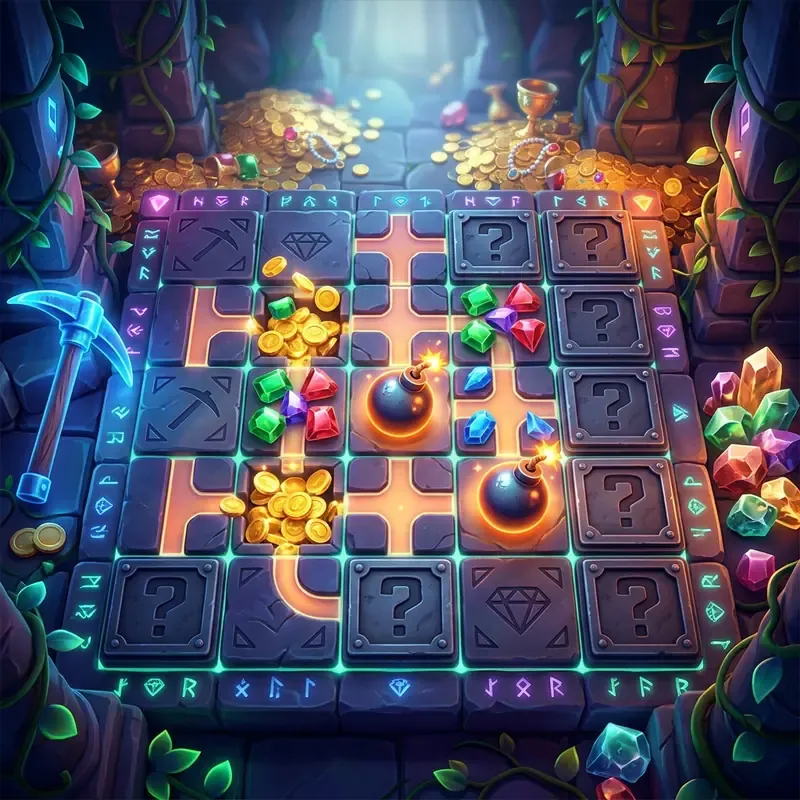
Quick verdict. Mines is a fast "instant win" casino game built on a grid of hidden tiles. You set a stake, choose how many mines are buried in the grid, then uncover tiles one at a time. Every safe tile lifts your multiplier, and one mine wipes the round. Published RTP ranges from 94% (Hacksaw Gaming) to 97% (Spribe) and up to 99% (Stake Originals), so the provider matters far more than any tactic. No betting system, whether Martingale, Paroli, Fibonacci or "10 Bets", can beat a negative expected value. The only things you genuinely control are stake size, mine count, cash-out discipline and session limits. If you are in Australia, read the legal and harm-minimisation sections before you deposit anything.
Provider

Stake Originals

RTP

99.00%

Volatility

Medium

Min bet

0.01
Mines Game Full Research Guide to

What this guide covers, and who should skip Mines

This is a terms-first review of the game rather than a promotional page. We work through the mechanics of the grid, the difference between mines demo and mines real money play, the RTP published by each provider, the probability maths behind the multipliers, the betting systems people sell online, mobile access without a fake download, and the safety tools available to Australian players. Every number is sourced from provider information panels or calculated from first principles, and we flag the claims we could not verify.

Who should give this one a miss?

  • Anyone hoping a "predictor" or hack script will produce a reliable edge. It cannot, and section 7.6 explains why.
  • Players chasing a welcome bonus, because instant games usually contribute 0–10% toward wagering.
  • Anyone who dislikes fast, high-frequency products. A Mines round can finish in under five seconds.
  • Australian residents who want the protections of a locally licensed operator, since real-money online casino games cannot lawfully be supplied here.

Still reading? Good. The detail below is what actually changes your outcomes.

What this guide covers, and who

  1. Positioning Mines in the landscape of online gambling

In two sentences: Mines sits in the "instant / crash-adjacent" category of online casino products, alongside Plinko, Dice and rising-multiplier games, where rounds last seconds and the player makes an active exit decision. That interactivity is exactly what makes the category commercially powerful and, from a harm perspective, worth scrutinising.

Mines is a direct descendant of Minesweeper, the deterministic logic puzzle bundled with Windows for decades. The casino adaptation strips out the deduction layer, since there are no adjacency numbers to reason from, and replaces it with a random distribution of mines across the grid, generated before your first click. What remains is a pure risk-escalation loop: uncover, bank, or push further.

Structurally, Mines belongs to the same family as rising-multiplier titles such as DraftKings Rocket, where players must exit before a crash and lose everything if they wait too long. In both cases the "skill" is not prediction but timing and stake control. Readers who want the wider commercial and regulatory context for this category can review our coverage of iGaming products, which maps how instant games, crash games and social casinos overlap.

Mines is marketed as a "game of skill" in some casino interfaces because players choose which tiles to uncover. Important qualification. We could not locate an independent audit of operator marketing language for this specific game, so treat any "skill game" framing as a marketing claim rather than a verified product attribute. The mine positions are set by an RNG before your first pick, which means no sequence of clicks is better than another at the moment of selection. Additional data on how operators present Mines in different jurisdictions is required.

The Australian context matters here. Regular online gambling participation in Australia carries measurably elevated harm indicators:

1. Positioning Mines in the landscape

«More than 70% of regular online gamblers in Australia scored 1 or more on the PGSI, indicating risk of gambling-related harm.» Australian Gambling Research Centre, National Gambling Trends Study (2023). https://www.agrc.org.au/

In the same body of work, 21.4% of participants met the criteria for high-risk gambling. Instant games such as Mines are notable because their round length is measured in seconds, which compresses the number of decisions, and losses, a player can experience per session.

2. Game mechanics: grid, mines, multipliers and cash out

In two sentences: A standard Mines round uses a 5×5 grid of 25 tiles, of which you choose how many hide mines (typically 1–24). Each safe pick multiplies your stake, and each additional pick raises both the multiplier and the cumulative chance of failure. You may cash out after any successful pick, but not mid-pick: once you click a mine, the stake is gone.

2.1 The three parameters you actually control

ParameterWhat it doesEffect on riskEffect on payout
Stake sizeSets the cash base of the roundScales absolute win/loss, not probabilityProportional
Number of minesSets grid difficulty (1–24 on 5×5)Raises chance of an early bustRaises multiplier per pick
Number of picks (tiles opened)Sets how long you stay in the roundCompounds bust probability each clickCompounds multiplier each click

Fewer mines create a slower, safer game. More mines deliver far higher multipliers but sharply increase the chance of an early loss. Grid size, where the provider allows it, works the same way in reverse: a larger grid with the same mine count is safer per click.

2.2 The round flow (block diagram in words)

Step 1, set the stake → Step 2, set the number of mines → Step 3, reveal tiles one by one → Step 4, decide: Cash Out or continue → repeat steps 3 and 4 until you bank or hit a mine.

Detailed sequence, as documented in provider help pages:

  1. Select your bet level and press Bet to begin.
  2. Click a tile to reveal either a diamond/gem or a mine.
  3. If a diamond appears, the current win value increases and another pick is granted.
  4. If a mine appears, the round ends immediately and all accumulated winnings for that round are lost.
  5. After any successful pick you can press Cash Out to bank the current win and close the round.
  6. Where supported, set grid size (3×3 to 9×9 on Hacksaw) and mine count (1–80 depending on grid) before the round starts.
  7. Available payouts depend on grid size, mine count and the number of completed picks.

That alt text on any step diagram, by the way, should describe the mines game flow in plain words, so screen-reader users get the same sequence.

2.2 The round flow block diagram

2.3 The multiplier maths (5×5 grid, provably fair 99% model)

The multiplier for opening k tiles on a 25-tile grid with m mines is derived from combinatorics:

Multiplier = RTP × C(25, k) ÷ C(25 − m, k)

and the probability of surviving all k picks is:

P(survive) = C(25 − m, k) ÷ C(25, k)

Which means expected value per round equals RTP, regardless of how you click. Worked examples at 99% RTP:

MinesTiles openedChance of survivingMultiplierExpected value
1196.0%×1.030.99
1388.0%×1.120.99
2284.3%×1.180.99
3549.6%×2.000.99
5529.2%×3.390.99
10319.8%×5.000.99
2414.0%×24.750.99

The single most important line in this article: every row above has the same expected value. Changing mines or picks changes volatility, not profitability. A 24-mine single-pick round is a coin-toss-style lottery. A 1-mine single-pick round is a slow grind. Both bleed the same 1%, or 3%, or 6%, per unit staked over time.

At 94% RTP the same combinatorics apply with a larger deduction, which is why a low-pick play on a large Hacksaw grid can return barely more than your stake. The house edge consumes most of the mathematical premium.

2.4 Comparison of Mines versions from leading providers

ParameterSpribe MinesHacksaw Gaming MinesStake Originals MinesNyx (BetMGM) Mines
Grid size5×53×3 to 9×95×55×5
Number of mines1–201–80 (grid dependent)1–24Adjustable
RTP97.00%94.00%~99.00%96.00%*
Max multiplier×10,000×10,000×10,000×10,000
Min / max bet$0.10 / $100$0.20 / $1,000$0.01 / $1,000$0.20 / $1,000
Release20213 March 2022Stake Originals suiteNyx / BetMGM exclusive
Stand-out featureAuto-play, "Open Random", Provably FairCustom grids (3×3 to 9×9)Highest published RTP, seed verificationClassic interface

* RTP for the Nyx build may differ by jurisdiction. This version is distributed exclusively through BetMGM in selected US states and Canadian provinces (MI, NJ, PA, WV and Ontario at the time of writing).

Fact-check note. The widely quoted claim that "the RTP for Mines is 94%" is accurate only for the Hacksaw Gaming build. Publishing that number without naming the provider misleads readers, because the Spribe and Stake Originals builds are materially different products with different paytables. Always check the in-game info panel for the RTP applied in your jurisdiction, and cross-check it against the provider's own game page.

RTP for the Nyx build may

3. Mines demo and real-money play

In two sentences: Demo Mines runs on a virtual credit balance with no deposit, no withdrawal and no financial risk, and is genuinely useful for learning the interface and paytable. Mines real money play uses your deposited funds, is subject to KYC and payment rules, and, critically, changes your psychology rather than the maths.

ParameterDemo / mines free modeMines real money mode
ObjectiveLearn controls, test mine counts and paytablesWin withdrawable funds
Balance currencyVirtual credits (resettable)Real deposited funds or crypto
Financial riskZeroFull stake at risk each round
WithdrawalsNot possiblePossible, subject to KYC, limits and processing
Bonus eligibilityNoneYes, but often at reduced wagering contribution
Player psychologyExperimental, low arousal, loss-insensitiveHeightened arousal, loss chasing, sunk-cost pressure
Best used forVerifying multiplier tables, testing auto-playNothing that you have not already tested in demo

Practical access notes: most demo builds are launched directly from provider showcase pages or aggregator libraries in-browser (HTML5), with no registration and no balance top-up. Some licensed casinos gate the demo behind a logged-in session. If a site demands a deposit before it will let you play Mines in demo, that is a signal to leave.

A crucial caveat that most Mines guides omit: free play is not a neutral warm-up.

«A longitudinal RCT with 556 young Australians found that the number of simulated gambling sessions significantly predicted increased real-money wagering the following week.» Longitudinal RCT cited in the AGRC simulated gambling report (2020). https://www.agrc.org.au/

There was no evidence of a "suppression" effect whereby simulated play reduced real-money gambling. In other words, mines demo is an effective onboarding tool for the operator as well as a learning tool for you. Use it to verify the paytable, then close it.

  1. Where and how Mines is played online

In two sentences: Mines online appears in three distinct environments, namely real-money casinos, sweepstakes or social casinos with Gold Coins and Stake Cash style economies, and free provider demos. Each has different legal exposure, different consumer protections and very different bonus mechanics.

Operators typically position Mines inside an "instant games", "originals" or "quick picks" lobby, cross-promoting it with Plinko, Dice, Keno and crash titles, and offering bonuses that span multiple game types. Those lobbies are usually where you will also find the featured games carousel, so the same product sits next to slots with wildly different volatility. For a broader view of legal platform categories and licensing, see our reference material on online casinos.

4. Where and how Mines is

4.2 Checklist for evaluating a casino offer that includes Mines

CheckWhat to verifyRed flag
LicenceNamed regulator and licence number, verifiable in the regulator's public register, for example the Malta Gaming Authority register or the Curaçao Gaming Control Board framework"Licensed and regulated" with no number, or a licence logo that isn't a live link
Original softwareGame loads from the named provider (Spribe, Hacksaw or Stake Originals), with an in-game info panel showing RTPUnbranded clones, no provider credit, no RTP disclosure
Independent testingRNG and RTP certification by a recognised lab such as eCOGRA or iTech LabsCertification claimed on the casino page only, with no lab reference
EncryptionTLS 1.2 or TLS 1.3 on all pages handling credentials and payments (RFC 5246 / RFC 8446)Mixed content warnings, no padlock at cashier
Bet limitsPublished min and max bet for Mines specificallyLimits only visible after depositing
Withdrawal limitsMin and max withdrawal, daily, weekly and monthly caps, feesMonthly caps lower than the max win the game advertises
Bonus termsWagering multiple, expiry, max cash-out, max bet while wagering, game contributionInstant games excluded after you accept the bonus
Provably FairSeed and hash verification available in-gameFairness claimed but no verification tool
Complaint historySearch the brand name with "withdrawal" and "verification" on independent forumsRepeated unresolved payout complaints, or reviews that all read like ad copy

4.3 Bonuses and Mines: the contribution trap

This is where most players lose a bonus rather than a bet. Instant and crash-style games, Mines included, commonly contribute 0–10% of turnover toward wagering requirements, versus 100% for many slots. A $100 bonus with 35× wagering means $3,500 of turnover on a 100% game, but potentially $35,000 of Mines turnover at a 10% contribution rate, which is mathematically unachievable for most bankrolls.

Bonus termTypical setting for instant gamesWhy it matters for Mines
Wagering contribution0–10%Turnover barely moves the requirement
Max bet while wagering$5 (often lower)Breaching it can void the entire balance
Max cash-out from bonus3× to 10× bonus amountCaps a big multiplier win
Excluded games listMines often listedPlay voids the bonus entirely
Expiry7–30 daysLow contribution plus a short clock equals a dead bonus

Always open the T&Cs and search for "Mines", "instant", "originals" and "contribution" before accepting any offer. It takes two minutes and it is the single cheapest piece of due diligence available to you.

4.4 Payments and withdrawals for Australian players (indicative)

MethodDeposit speedWithdrawal speedTypical limitsNotes
PayID / OskoInstant1–2 business days$10 to $10,000+Widely offered by offshore sites; bank blocks are common
Visa / MastercardInstantOften not supported for payouts$20 minGambling-coded transactions are frequently declined by AU banks
Neosurf voucherInstantDeposit only$10 to $1,000Prepaid; payout must go via another method
Bank transfer1–3 days2–7 business days$50 to $50,000Slowest, but best for large sums
Crypto (BTC, ETH, USDT, LTC)5–60 min10 min to 24 hoursNetwork dependentFastest, but adds price volatility and no chargeback

Figures are indicative only and must be confirmed against the operator's cashier page and current terms. Expect KYC, meaning photo ID, proof of address and sometimes source of funds, before your first withdrawal is released, not after. Verification requests that arrive only when you try to cash out a win are the most common source of frustration in this category.

  1. Step-by-step: from your first bet to a withdrawal

1
Set a session budget and a loss limit before you open the game. Write both numbers down. Mines rounds take seconds, so decisions made mid-session are made under time pressure.
2
Open the demo first. Confirm the multiplier table for the mine counts you intend to use, and confirm the RTP shown in the info panel.
3
Register and complete KYC early. Verifying at signup prevents a "verification hold" the first time you try to withdraw a win.
4
Deposit the smallest amount that lets you play your planned stake for your planned number of rounds. For a $0.20 stake across 100 rounds, that is $20, not $200.
5
Decline the welcome bonus unless Mines contributes meaningfully. See section 4.3.
6
Set your stake, then your mine count. Stake first prevents accidental over-betting when switching risk profiles.
7
Open tiles and cash out at a pre-decided target. Decide before the round: two tiles, then bank. Do not renegotiate mid-round.
8
Use auto-play with a stop-loss and stop-win, if available. Automation removes tilt but also removes friction, so set both caps.
9
Withdraw promptly. A banked win that stays in the casino balance is, statistically, a future bet.
10
Log your session. Stake, mines, picks, result. After 200 rounds your own log will show you the house edge more convincingly than any article, including this one.

6. RTP, house edge and risk perception in Mines

In two sentences: RTP is a long-run theoretical average, so 97% on Spribe Mines means an expected return of $97 per $100 staked across a very large number of rounds, not per session. Research shows most players systematically misread that number in the operator's favour.

6.1 Mathematical RTP vs a short session

Spribe publishes 97.00% RTP for Mines. That figure is the expected value of the distribution, and it converges only across tens or hundreds of thousands of rounds. A 40-round session is a tiny sample. It can finish at +400% or −100% without contradicting the published RTP in any way. Volatility, not RTP, determines what your evening looks like.

House edge, expressed the other way round:

Provider buildRTPHouse edgeExpected loss per $100 turnover
Stake Originals Mines99.00%1.00%$1.00
Spribe Mines97.00%3.00%$3.00
Nyx (BetMGM) Mines96.00%4.00%$4.00
Hacksaw Gaming Mines94.00%6.00%$6.00

Note the compounding effect of turnover, because Mines rounds are fast. At 300 rounds per hour and $1 per round, a 6% edge costs an expected $18 per hour, roughly six times the cost of a 1% edge on the same volume. Same game, same screen, six times the price.

6.2 How players misread RTP

«A typical 90% RTP message significantly increased perceived chances of winning; only about 37.5% of participants interpreted it correctly.» Weiss-Cohen et al., Addictive Behaviors (2025). https://www.sciencedirect.com/journal/addictive-behaviors

In that research, participants exposed to RTP framing reported substantially higher perceived likelihood of winning, with odds ratios greater than 5, meaning they were more than five times as likely to say they were likely to win. The reframing effect is measurable and reversible:

«House edge phrasing was correctly understood by 57.7% of participants, versus 37.5% for standard RTP phrasing.» Newall et al., Addiction Research & Theory (2023). https://www.tandfonline.com/journals/iart20

An original house edge phrasing, less extreme in tone, produced both lower perceived chances of winning and higher rates of correct understanding compared with RTP. Practical takeaway: whenever you see "97% RTP" on a Mines interface, mentally rewrite it as "the operator keeps 3% of everything I stake, every round, forever." That single translation is the highest-value habit in this article.

7. Mines strategy and betting systems (with simulations)

In two sentences: Every Mines strategy is either a bankroll-management rule or a staking progression, and none alters the expected value of a round, because mine placement is set by the RNG before your first click. Below we simulate the two most popular systems in full so you can see exactly where they break.

«With a non-zero house edge, both Martingale and Paroli produce negative expected value; progression changes the distribution of outcomes, not the final result.» Pflaumer et al., Analysing Paroli and Let-It-Ride Betting Systems (2023). https://www.tandfonline.com/

Martingale and Paroli are mirror images, differing only in whether bets increase after wins or losses. The analytical formulas and Monte Carlo simulations in the research above converge on the same conclusion: progression redistributes when and how you lose, and nothing else.

7.1 Mathematical breakdown of the Paroli strategy (positive progression)

Paroli doubles the stake strictly after a win and returns to the base stake after a loss. This limits drawdown during losing streaks, which is why conservative players prefer it to Martingale.

Simulation model, 10 rounds. Grid 5×5, 2 mines, target 2 safe tiles = ×1.18 (99% RTP model). Base stake $10, win-streak cap of 3 steps.

RoundStake ($)PicksResultMultiplierReturn ($)Step P/L ($)Running balance ($)
110.002 safeWin×1.1811.80+1.80+1.80
211.802 safeWin×1.1813.92+2.12+3.92
313.92mine hitLossn/a0.00−13.92−10.00
410.002 safeWin×1.1811.80+1.80−8.20
511.802 safeWin×1.1813.92+2.12−6.08
613.922 safeWin×1.1816.42+2.50−3.58
710.00 (reset)2 safeWin×1.1811.80+1.80−1.78
811.80mine hitLossn/a0.00−11.80−13.58
910.002 safeWin×1.1811.80+1.80−11.78
1011.802 safeWin×1.1813.92+2.12−9.66

Expert conclusion: eight wins out of ten rounds, an 80% hit rate against an 84.3% theoretical survival rate, and the sequence still finishes at −$9.66. That is the entire lesson. Paroli protects the bankroll better than Martingale, but a bust on step three of the progression erases several small wins, because the losing stake is always the largest one in the sequence.

A longer illustration on a 1-mine, ×2.14-target configuration over 20 rounds can finish marginally positive, +1.52 units in one published sample, which is precisely the trap. Short samples of a negative-EV system routinely look profitable.

Expert conclusion eight wins out of

7.2 Martingale in Mines (negative progression) and why it fails fastest

The rule: after every losing round, increase the stake so a single win recovers all prior losses plus one unit, then reset to base after a win. In Mines this is usually combined with a low mine count and an early cash out, say 1 mine, 3 picks, ×1.12. But a low multiplier makes recovery harder, because you need a much bigger stake to claw back the same loss.

Stake escalation at a ×2.00 target (3 mines, 5 picks), base $5:

Consecutive lossesRequired stake ($)Cumulative risk ($)Probability of reaching this step
055n/a
1101550.4%
2203525.4%
3407512.8%
4801556.5%
51603153.3%
63206351.6%
76401,2750.8%
81,2802,5550.4%

A run of eight consecutive busts occurs roughly once every 250 sequences, trivially common across a few evenings of play, and it demands $1,280 on a single round to recover a $5 base. At a ×1.12 target the escalation is far worse: recovery requires roughly a 9× stake increase per step, and the table limit is reached in three or four losses. Martingale converts a small, steady expected loss into a rare, catastrophic one. The maths of the edge is unchanged. The Anti-Martingale variant, which raises stakes after wins instead, is simply Paroli under another name, with the same expectation.

7.3 The "1:1 Ratio" strategy (low risk, high volume)

Designed for minimum variance and for grinding low-contribution wagering:

  1. Set 1 mine on a 5×5 grid.
  2. Open exactly 1 tile per round.
  3. Survival probability = 24/25 = 96%.
  4. Multiplier for one tile ≈ ×1.03.
  5. Press Cash Out immediately after the first click.

Across 100 automated rounds this preserves roughly 97–99% of the bankroll depending on the provider's RTP, which is the honest description of the "best" Mines strategy: it loses the least, slowest. It never wins in expectation.

7.4 The "More Mines" approach (high risk)

Increase mine count to lift the multiplier per safe pick. With 10 mines and 3 picks the multiplier reaches ×5.00, but survival drops to 19.8%. This is a volatility choice, not an edge, since expected value is identical to the 1:1 approach. Use it only with money you have already written off, and with a hard stop-loss.

7.5 Seven more tactics, honestly assessed

TacticHow it worksHonest verdict
FibonacciRaise stake along 1-1-2-3-5-8 after lossesSlower escalation than Martingale, same terminal risk
D'Alembert+1 unit after loss, −1 after winGentlest progression; still negative EV
"10 Bets" systemFour series of 10 rounds at 13 / 8 / 6 / 4 mines, with the next series' stakes derived from the previous series' results, tracked on paperExcellent discipline tool, zero mathematical advantage; stop after 10 to 12 completed lines
Pattern picking (corners, diagonals, edges)Click a fixed shape each roundNo advantage whatsoever, because mines are pre-placed randomly; it only speeds up play, which increases turnover and expected loss
"Safe and Sound"Set a target profit per round and cash out the instant it is reachedThe single most useful habit here, because it enforces a decision made before arousal peaks
"Mine Master"Push as deep as possible each roundMaximum volatility; expect long dry spells
"Jack-of-all-trades"Rotate styles for varietyEntertainment framing, not strategy

Take these as a risk map rather than a ranking. None of these Mines strategies delivers a guaranteed win, and any table that suggests otherwise is selling something.

7.6 Red flags: "Mines predictor", hack scripts and signal bots

There is a thriving scam economy around this game. Understand why it cannot work, then you cannot be sold it.

  • Mine positions are generated before your first click, from a server seed the operator commits to cryptographically. No client-side script can read them.
  • In a Provably Fair implementation, the outcome is fixed by Server Seed + Client Seed + Nonce. If a bot could derive it, the SHA-256 commitment would be broken, and that would be global news rather than a $29 Telegram subscription.
  • Common scam patterns to refuse outright: a "Mines predictor APK", "hack signals" Telegram channels, paid "AI bots" with 95% win screenshots, affiliates demanding you sign up via their link so the "hack works only on that casino", and anyone requesting your casino login or API key.
  • Screenshots and win videos are trivially fabricated in demo mode, where the balance resets and nothing is real.

Rule: any product promising a guaranteed win, a "100% strategy" or a way to see mine positions is a scam or a phishing vector. There are no exceptions.

7.6 Red flags Mines predictor

7.7 What actually improves your outcomes

  • Choose the highest published RTP build available to you. A 5-point RTP difference dwarfs every tactical decision in this section.
  • Reduce turnover, not stake alone. Fewer rounds per hour means less expected loss.
  • Fix your cash-out target before the round starts.
  • Never chase. Loss-chasing is the mechanism by which a fast game becomes an expensive one.
  • Test everything in demo first, then accept that a demo win proves nothing.

8. Mines on mobile and the convergence with digital gaming

In two sentences: There is no standalone official "Mines APK" from Spribe, Hacksaw or Stake, because Google Play and the App Store restrict real-money gambling apps in most markets. You reach mines mobile either through a browser-based PWA shortcut or through a casino's own Android client.

8.1 Browser (HTML5) vs native app

CriterionMobile browser / HTML5Casino APK / iOS app
SetupNone, just open and playDownload, permissions, install
Launch speedFast, no install stepFaster after install, larger first-time cost
ControlsBrowser chrome consumes screen spaceFull-screen, native gestures
UpdatesAutomatic, server-sideManual or in-app updater
StorageNear zero30–120 MB typical
Security exposureDepends on HTTPS/TLS and browser hygieneSideloaded APKs carry malware risk; verify the source domain
Best forCasual sessions, demo testingFrequent players wanting notifications and biometric login

8.2 How to install Mines on Android and iOS: step-by-step

No official standalone Mines download exists in Google Play or the App Store, because both stores restrict real-money gambling titles. Two safe routes remain.

Method 1, install the web app (PWA), iOS and Android

  1. Open your mobile browser, Safari on iOS or Chrome on Android, and go to the licensed casino's site.
  2. Tap Share on iOS, or the three-dot menu on Android.
  3. Choose Add to Home Screen.
  4. A Mines or casino icon appears on your home screen, launching full-screen with no store updates required.

Method 2, download the casino's official Android client (APK)

  1. Go to the "Mobile apps" section on the casino's own website, never a third-party APK mirror.
  2. Download the .apk file and check the file size and publisher against the site's stated values.
  3. In Android settings, allow installation from unknown sources for that browser only, then revoke it afterwards.
  4. Install, sign in, and search for Mines in the game lobby.
  5. Keep the client updated, since updates commonly include security patches.

Security hygiene for mobile play: download only from the operator's own domain or an official store, use a long unique password and two-factor authentication where offered, never install a "Mines app" from a Telegram link, and verify the casino's licence before you deposit.

8.2 How to install Mines on

8.3 The convergence problem

Mobile play is associated with more frequent, shorter sessions and may be more likely to occur in private or solitary settings. Qualification. We found no directly matching peer-reviewed source for this pattern in the specific context of instant games such as Mines, so treat it as a hypothesis pending dedicated research rather than an established finding.

An additional regulatory challenge is aesthetic convergence, because Mines looks and feels like a mobile puzzle game. The grid, the gem icons, the tap-to-reveal loop and the instant feedback are indistinguishable from a free casual title. That lowers the perceptual barrier between "game" and "wager", particularly for younger users who grew up with loot boxes and social-casino apps.

8.3 The convergence problem. Mobile play

9. Safety, harm and consumer protection

Disclaimer. This information is general in nature and does not replace professional advice. If you are experiencing problems with gambling, contact Gambling Help Online (1800 858 858) or the national gambling helpline in your state.

In two sentences: Mines combines short round length, adjustable volatility and an active exit decision, a combination that supports rapid, repeated betting. Protective tooling exists, but its measured effectiveness lags well behind the sophistication of the products themselves.

9.1 The evidence on early exposure

«Young people who engaged in simulated gambling at 16–17 were 40% more likely to begin real-money wagering at 18–19.» Growing Up in Australia longitudinal study, cited in the House of Representatives Committee report (2023). https://www.aifs.gov.au/

That is a clear risk trajectory, and it is directly relevant to Mines, which is heavily promoted in free and demo form across aggregator sites and social casinos with no age gate stronger than a checkbox.

9.2 Operator tooling and data asymmetry

Licensed operators offer deposit limits, loss limits, session reminders, cooling-off periods and self-exclusion. However, empirical evaluations of operator-implemented harm-minimisation tools remain sparse. Online environments also let operators collect detailed behavioural data on players, potentially enabling targeted marketing. Qualification. The targeted-marketing inference is plausible given how iGaming CRM systems function, but we could not locate peer-reviewed measurement of that practice in relation to instant games specifically, so independent empirical verification is required before treating it as established fact.

9.2 Operator tooling and data asymmetry

9.3 Practical safeguards for Australian players

ToolWhat it doesHow to use it
BetStopAustralia's National Self-Exclusion Register, which blocks licensed interactive wagering servicesRegister free at betstop.gov.au for 3 months to lifetime
Gambling Help OnlineFree 24/7 counselling, chat and email support1800 858 858
Deposit limitsCaps money entering the accountSet at signup, before the first deposit
Loss and session limitsCaps money and time inside a sessionSet lower than you think you need
Bank gambling blockMost major AU banks can block gambling transactionsRequest in your banking app
Device-level blockingBlocks gambling domains outrightRouter or DNS filters, or blocking software

9.4 Warning signs specific to fast instant games

  • Playing more rounds per session than you planned, without noticing the round count.
  • Increasing stakes after a loss "just to get back to even".
  • Switching to high mine counts for a fast recovery.
  • Playing Mines while unable to name your session's net result.
  • Searching for predictors, bots or hacks, which is a recognised late-stage chasing behaviour rather than a technical project.

Responsible gambling statement. Gambling involves the risk of financial loss. You must be of legal age, 18+ in Australia and 21+ in some jurisdictions. Never gamble with money you cannot afford to lose, never gamble to solve financial problems, and verify the legality of online gambling in your jurisdiction before you play.

9.4 Warning signs specific to fast

  1. Provably Fair: verifying a round with SHA-256

In two sentences: Provably Fair lets you confirm that the mine layout was fixed before your first click and never changed during the round. It does not make the game profitable. It makes it auditable.

How the commitment works in Spribe and Stake-style implementations:

  1. Before the round, the server generates a Server Seed and publishes its SHA-256 hash, the commitment.
  2. Your browser generates a Client Seed, which you can usually edit manually. Do edit it, since it strengthens the guarantee.
  3. Combined with a Nonce, the round counter, Server Seed + Client Seed + Nonce deterministically produces the shuffle that places the mines.
  4. After the round ends, open the game settings and click Provably Fair, sometimes labelled "Fairness" or "Verify".
  5. Reveal the unhashed Server Seed, paste it into any third-party SHA-256 calculator, and confirm the output matches the hash published before the round.
  6. If the hashes match, the mine positions could not have been altered mid-round.

What Provably Fair does not do: it does not change the RTP, does not guarantee wins, and does not certify the paytable's fairness in a commercial sense. For that, look for RNG and RTP certification from an independent lab such as eCOGRA or iTech Labs, verified on the lab's own site rather than the casino's marketing page. Encryption in transit should be TLS 1.2 (RFC 5246) or TLS 1.3 (RFC 8446) on every page that handles credentials or payments.

10. Provably Fair verifying a round

  1. FAQ: Mines questions Australian players ask

What is Mines and how does it work?

Mines is an instant casino game on a grid of hidden tiles, usually 5×5 with 25 tiles. You set a stake, choose how many mines are hidden, then uncover tiles one at a time. Each safe tile raises your multiplier, and one mine ends the round and forfeits the round's winnings. You can cash out after any successful pick.

What is the RTP of Mines?

It depends entirely on the provider. Stake Originals Mines is published at around 99%, Spribe at 97.00%, Nyx (BetMGM) at 96%, and Hacksaw Gaming at 94.00%. Any article quoting a single RTP for "Mines" without naming the provider is imprecise. Always check the in-game info panel, since RTP can also vary by jurisdiction.

How many mines can I set?

Stake Originals allows 1 to 24 mines on a 5×5 grid, Spribe allows 1 to 20, and Hacksaw allows a custom grid from 3×3 to 9×9 with up to 80 mines. More mines means higher multipliers and a much higher chance of an early bust, while expected value stays the same.

What is the minimum bet in Mines?

As low as $0.01 on Stake Originals, $0.10 on Spribe, and $0.20 on Hacksaw and Nyx builds. Maximum bets typically run to $100 or $1,000 depending on provider and operator.

Can I win real money playing Mines?

Yes. Outside demo mode, wins are paid in real funds up to the game's cap, commonly ×10,000 of stake. Withdrawals are handled by the casino cashier, subject to KYC, method limits and processing times, not by the game itself.

Is there a Mines app I can download?

There is no standalone official Mines app in Google Play or the App Store, because both restrict real-money gambling titles. You either add the casino site to your home screen as a PWA, or download the casino's own Android APK from its official domain. Anything advertised as a "Mines APK with predictor" is a scam.

Do Mines predictor bots or hacks work?

No. Mine positions are generated and cryptographically committed before your first click. No client-side script or Telegram bot can read or influence them. These products are scams or phishing tools.

Which strategy is best in Mines?

None produces a mathematical advantage. The lowest-variance approach is the 1:1 ratio, meaning 1 mine, 1 tile and an immediate cash out. The most disciplined is a pre-set cash-out target with a hard stop-loss. Progressions such as Martingale and Paroli change the shape of your losses, not their expectation.

When should I cash out?

At a target you decided before the round began. The longer you stay in a round, the higher the cumulative chance of hitting a mine, and the larger the amount you stand to forfeit.

Do Mines bets count toward bonus wagering?

Often only 0 to 10%, and sometimes not at all. Instant and "originals" games are frequently excluded or heavily discounted. Check the bonus terms for "instant games" and "contribution" before accepting an offer.

Is Mines legal for players in Australia?

Real-money online casino games, including instant games like Mines, cannot lawfully be supplied to Australian residents under the Interactive Gambling Act 2001. Australians who play do so at offshore sites with reduced consumer protections. Free demo play is a different matter, but it carries its own documented risk of escalation to real-money wagering.

Can I play Mines on mobile?

Yes. All four major builds are HTML5 and run in mobile browsers on iOS and Android, with optional home-screen (PWA) installation or a casino Android client.

  1. About the author and methodology

This guide was produced by our iGaming research desk, with more than three years of hands-on analysis of instant-win and crash-style casino products, provider paytables and operator terms. Our related work on market structure, licensing and product categories is collected in our iGaming research hub.

Methodology and limitations. Provider parameters, meaning RTP, grid sizes, mine counts and bet limits, were taken from vendor game-information panels and help centres. Multiplier and probability figures in section 2.3 were calculated from first principles using the combinatorial formula shown, at a 99% RTP baseline, and will differ on builds with a larger house edge. Harm and risk-perception findings are cited to their original publications. Where we could not verify a claim against a primary source, specifically operator marketing language, targeted-marketing practices and mobile session patterns for instant games, we have said so explicitly rather than presenting it as fact. Payment limits and processing times are indicative and change frequently, so confirm them with the operator before you act.

General disclaimer. This article is informational and analytical. It is not financial, legal or medical advice, and it is not an inducement to gamble. Gambling carries a risk of financial loss. 18+, and 21+ in some jurisdictions. If gambling is causing harm to you or someone you know, contact Gambling Help Online on 1800 858 858 or register with BetStop, Australia's National Self-Exclusion Register.

12. About the author and methodology